


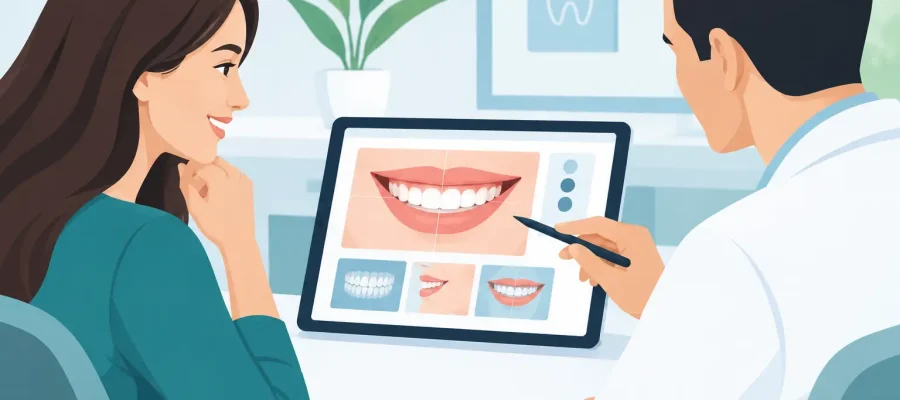
A smile makeover should never begin with drilling, whitening, or placing a veneer. It should begin with a clear answer to one question: how do you plan a smile before treatment? The best outcomes are engineered before the first procedure, using your facial features, bite, dental health, and personal style to create a result that looks intentional from every angle.
For international patients, planning also protects your time. When you are traveling for veneers, crowns, implants, or a complete Hollywood Smile, you need more than a promising before-and-after photo. You need to see the direction of your result, understand the treatment sequence, and know what can realistically be completed during your visit.
How Do You Plan a Smile Before Treatment? Start With the Face
Teeth do not exist in isolation. A bright, perfectly shaped set of veneers can still look wrong if the proportions do not suit your lips, facial width, gum line, or natural expressions. Smile planning begins by studying the full picture, not just the teeth visible in a close-up photo.
A clinical team evaluates how much tooth and gum tissue shows when you speak, smile, and rest your lips. They consider the curve of the lower lip, the position of the midline, the width of your smile, and the balance between your upper and lower teeth. Facial symmetry matters, but it is not about forcing every detail into a ruler-straight line. Natural faces have character. The goal is harmony, not an artificial copy-and-paste smile.
Photos and short videos are especially valuable because a still image cannot show how a smile moves. Someone with a high smile line may need more attention to gum contouring and ceramic margins. A patient whose lips cover most of the teeth at rest may benefit from a different tooth length than someone who naturally shows a lot of upper incisors.
Your goals shape the design
A signature smile is personal. Some patients want a bold, camera-ready Hollywood Smile with high brightness and strong definition. Others want a refined upgrade that looks like they were simply born with exceptional teeth. Both can be premium results, but they require different choices.
During consultation, the planning conversation should cover the color, length, shape, texture, and overall personality of the smile. Square teeth can create a stronger, more structured look. Softer contours often feel more youthful or feminine. Very white shades can be striking under studio lights, but a more natural white may suit a professional setting and blend better with existing teeth.
The right answer depends on your goals, skin tone, facial features, age, and the condition of your natural teeth. A good plan does not push every patient toward the same shade or veneer shape.
The Clinical Foundation Comes Before Aesthetics
Beautiful ceramics need healthy support. Before planning E-Max veneers, zirconium crowns, or whitening, the dentist checks for issues that could compromise the final result, including cavities, gum inflammation, old leaking restorations, cracked teeth, uneven bite forces, and signs of grinding.
This examination may include digital X-rays, 3D scans, intraoral photographs, and a detailed bite assessment. If a tooth is weak, heavily filled, or root canal-treated, it may need a crown rather than a thin veneer. If missing teeth affect the smile or chewing function, an implant plan may be needed before the cosmetic phase. For full-arch cases, bone levels and sinus anatomy can determine whether immediate implants, bone grafting, or a staged approach is appropriate.
This is where clinical discipline protects the cosmetic investment. Whitening may be ideal for healthy natural teeth, while veneers can correct color and shape at the same time. Gum aesthetics may be necessary if the gum line is uneven. Masseter Botox may help selected patients who clench or have jaw-muscle tension, but it is not a substitute for diagnosing a bite problem or protecting restorations with a night guard.
Digital Smile Design Turns Ideas Into a Visible Plan
Digital Smile Design connects facial analysis, dental scans, and aesthetic goals in one planning process. Your teeth are scanned digitally, then evaluated alongside high-quality facial images and bite records. The team can build a proposed smile with precise changes to tooth width, length, edge position, and gum symmetry.
For a patient traveling from the US, this is a major advantage. Instead of arriving with vague expectations, you can review the proposed direction before treatment moves forward. A 3D preview makes it easier to discuss details that are difficult to explain in words, such as whether the front teeth should be one millimeter longer, whether the smile should appear wider, or whether a softer shape feels more like you.
Digital planning is powerful, but it is not a guarantee that every computer image can be copied exactly in the mouth. Natural enamel, gum response, bite mechanics, and facial movement all influence the final result. The preview is a sophisticated roadmap, then the dentist refines it through clinical judgment and real-world try-ins.
The mock-up is where the smile becomes real
A physical or temporary mock-up is one of the most useful steps in smile design. It allows you to see a proposed shape directly on your teeth before final ceramics are placed. You can look at it in a mirror, speak, smile, and take photos from your usual angles.
This is the moment to give specific feedback. Do the teeth feel too long? Is the smile bright enough? Does the shape look polished but still like you? Small adjustments at the mock-up stage can make a meaningful difference to the final veneer or crown design.
Mock-ups also help the dentist plan conservative preparation. When the desired tooth position is mapped in advance, the team can remove only the amount of enamel necessary for the material and design. In some cases, minimal-prep veneers are possible. In others, more preparation is needed to correct severe discoloration, protrusion, large restorations, or major alignment issues. Honesty about this trade-off is essential.
Planning the Timeline for Treatment and Travel
A smile plan should include a treatment calendar, not just a design. Same-day CAD/CAM crowns and immediate implant protocols can shorten treatment time for suitable candidates, but fast treatment still depends on diagnosis, healing requirements, and the complexity of the case.
A straightforward veneer or crown makeover may be completed within a focused visit after planning and preparation. Implant cases may involve temporary fixed teeth first, followed by final restorations after healing and integration. Patients with gum disease, active infection, or extensive bone loss may need treatment phases that cannot safely be compressed into one trip.
At DRGO Smile Clinic, the planning process is designed around both clinical precision and the realities of international travel. That means coordinating records, treatment stages, and appointments before arrival, while allowing enough time for design approval, try-ins, and final adjustments. Concierge support can simplify transfers, accommodation, and communication, but it should never replace proper medical planning.
Questions to Ask Before You Approve a Smile Plan
Before committing, make sure you understand what is being proposed and why. Ask which teeth will receive veneers or crowns, whether any healthy teeth require preparation, what shade system will be used, and how the new smile will work with your bite. If implants are involved, ask whether you will receive temporary or final teeth during the visit and what follow-up is required at home.
You should also ask what happens if the digital design needs changes after you see the mock-up. A premium smile makeover leaves room for refinement. The goal is not to rush you into a template. It is to move efficiently toward a result you feel confident wearing in close conversation, on camera, and years after the treatment is complete.
The most rewarding smile transformations begin when you can picture the result, understand the clinical path, and approve a design that feels unmistakably yours. Start with a detailed consultation, bring honest reference photos and expectations, and let the plan earn your confidence before treatment begins.