


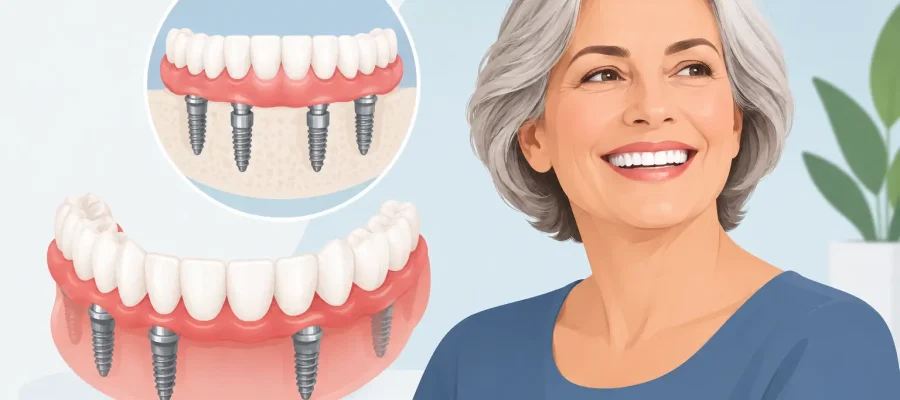
A loose denture can change more than the way you eat. It can make business dinners, photos, travel, and even spontaneous laughter feel calculated. This guide to full arch implants explains how patients can replace an entire upper or lower row of failing or missing teeth with a fixed, natural-looking smile designed for daily life.
Full arch treatment is a major clinical decision, but it does not need to be a confusing one. The right result combines surgical planning, bite design, facial aesthetics, and a clear travel timeline. For international patients, the process should also be organized around comfort: airport transfers, accommodation, language support, and a treatment plan that tells you exactly what happens before you book.
What Are Full Arch Implants?
Full arch implants replace all teeth in one jaw with a fixed bridge supported by dental implants. Rather than placing one implant for every missing tooth, a surgeon places a strategic number of implants in areas of healthy, dense bone. A custom full-arch bridge is then attached to those implants.
The treatment is often called All-on-4 or All-on-6. The names describe the number of implants supporting the arch, not the number of teeth being replaced. Your final bridge may restore a complete smile line while using four or six implants as its foundation.
For many candidates, the biggest difference is stability. A removable denture rests on the gums and can shift. A fixed implant bridge is secured to the implants, so it is designed to feel more like teeth and allows you to speak, smile, and eat with greater confidence.
A full arch restoration is not simply a set of white teeth. It is an engineered smile. The dentist must assess gum display, lip support, tooth proportions, facial symmetry, jaw position, and the way your upper and lower teeth meet. A beautiful result that creates an unstable bite is not a premium result.
Who Is a Candidate for Full Arch Implants?
Full arch implants may suit patients who have lost most or all teeth in an arch, wear uncomfortable dentures, or have teeth that are severely decayed, loose, heavily restored, or affected by advanced gum disease. They can also be appropriate when saving each remaining tooth would require years of repeated treatment with an uncertain long-term outcome.
Candidacy depends on more than how your smile looks. Your clinician will evaluate bone volume, gum health, medical history, bite forces, smoking habits, and healing capacity. Patients with diabetes, a history of periodontal disease, teeth grinding, or certain medications may still be candidates, but planning and maintenance need to be more precise.
Bone loss does not automatically rule out treatment. Angled implant placement can sometimes avoid areas with limited bone, especially in All-on-4 planning. In other cases, bone grafting or a sinus lift may be the more responsible choice. A clinic that promises the same technique to every patient is prioritizing speed over diagnosis.
All-on-4 vs. All-on-6: What Is the Difference?
All-on-4 uses four implants to support one full bridge, usually with the rear implants positioned at an angle to maximize existing bone. It can be an efficient option for patients with limited posterior bone and may reduce the need for grafting.
All-on-6 uses six implants. The additional support can be valuable when anatomy allows it, particularly for patients with stronger bite forces or when the treatment plan calls for broader load distribution. More implants are not automatically better. The best choice depends on the quality and shape of your bone, your bite, and the final bridge design.
Think of it this way: the goal is not to select a number before your consultation. The goal is to create a stable foundation for your specific smile, with no unnecessary surgery and no shortcuts that compromise long-term performance.
The Full Arch Implant Process, Step by Step
A predictable transformation starts well before surgery. At DRGO Smile Clinic, full arch cases are planned with a digital-first approach so the team can assess function and aesthetics before treatment begins.
1. Digital consultation and treatment design
The process begins with your medical and dental history, recent X-rays or scans when available, photos, and a conversation about your goals. If you want a brighter, more youthful smile, that matters. If your priority is being able to eat confidently again, that matters too.
Once you arrive, 3D imaging and a clinical examination provide the detail needed for final planning. The team evaluates bone, nerves, sinus areas, gums, and bite. Digital Smile Design can help visualize tooth shape, smile width, and facial harmony before a final prosthetic direction is approved.
2. Preparing the foundation
If damaged teeth remain, they may need to be removed. The surgeon then places implants according to the digital plan. When immediate loading is clinically appropriate, a temporary fixed bridge can be attached soon after implant placement.
This is the stage many patients describe as receiving fixed teeth immediately. That phrase requires context: the first bridge is usually a carefully designed temporary restoration, not the final ceramic bridge. It restores appearance and function during healing, while the implants integrate with the bone.
3. Healing with a fixed provisional smile
Healing is not downtime without purpose. During the following months, the implants and surrounding bone need time to form a stable connection. You will generally follow a softer-food diet at first and receive instructions for cleaning around the bridge, managing swelling, and protecting the surgical sites.
The provisional bridge also gives your care team valuable information. It reveals how your bite feels, how your speech adapts, and whether the tooth length, lip support, and smile line need refinement before the final restoration is made.
4. Final bridge design and placement
After healing, the team takes new records for your definitive bridge. Materials may include high-strength zirconia or other restorative options selected for aesthetics, durability, and your bite requirements. The final teeth are then shaped, shaded, and adjusted to create a natural expression rather than a generic, overly bright smile.
This stage is where precision becomes visible. Small changes in tooth texture, translucency, contour, and bite can separate a smile that merely looks new from one that looks like it belongs to you.
How Long Does Treatment Take for International Patients?
Your first visit can often include diagnostics, surgery, implant placement, and an immediate temporary bridge when your clinical condition permits it. Many patients stay long enough for surgical follow-ups and early bite adjustments before returning home.
The final bridge is typically placed after a healing period of several months. The exact timeline varies with bone quality, whether extractions or grafting are needed, your general health, and whether the implants achieve the stability required for immediate loading.
For travelers, planning should be realistic rather than rushed. Ask exactly how many visits are expected, how long each visit requires, what is included in the package, and how aftercare will be coordinated once you are back in the US. A premium experience is not only about a five-star hotel or VIP transfer. It is about having a clinical schedule that respects biology.
What Affects Full Arch Implant Cost?
The price of full arch implants can vary significantly because the treatment is not one single product. It may include extractions, sedation, 3D imaging, implant surgery, temporary teeth, the final bridge, bone grafting, sinus procedures, laboratory work, and follow-up appointments.
Material choice also matters. A final zirconia bridge may carry a different cost profile from other restorative materials, while complex bone reconstruction adds both treatment time and surgical planning. A low headline price can leave out essential stages, so a clear written plan is more useful than a vague starting figure.
For patients considering treatment abroad, compare total value rather than the procedure line alone. Include accommodation, local transportation, translation, clinical support, follow-up planning, and the quality of the final restoration. Transparent package pricing should make the investment easier to understand, not harder to decode.
Questions Worth Asking Before You Commit
Ask who will perform the surgery and who will design the final teeth. Implant surgery and smile design are connected, but they require different areas of expertise. You should also ask whether a temporary fixed bridge is included, which final material is proposed, and what happens if grafting becomes necessary after your 3D scan.
Ask to see cases with a starting point similar to yours, not only perfect after photos. If you grind your teeth, ask how the bridge and bite will be designed to manage that force. Finally, make sure you understand the cleaning routine and maintenance schedule. Full arch implants are fixed, but they are not maintenance-free.
The best full arch result gives you more than a new set of teeth. It gives you the confidence to show up fully – at the table, in the camera frame, and in every moment you once spent trying to hide your smile.