


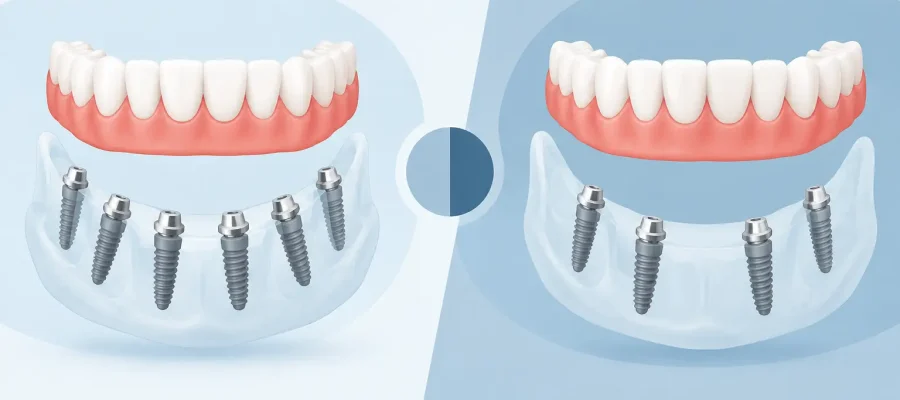
A full arch of fixed teeth can change far more than your bite. It can change how you eat in public, speak on camera, smile in photos, and feel when you meet someone new. When comparing all on 6 vs all on 4 implants, the question is not simply which treatment uses more implants. It is which foundation can support your new smile with the right balance of strength, aesthetics, timeline, and long-term confidence.
Both treatments replace an entire upper or lower arch using a fixed bridge secured to dental implants. Both can be life-changing for patients with failing teeth, advanced tooth loss, loose dentures, or years of hiding their smile. The right choice depends on your bone quality, jaw anatomy, bite forces, facial goals, and the treatment plan created after detailed imaging.
What All-on-4 and All-on-6 Actually Mean
All-on-4 uses four strategically positioned implants to support a full-arch fixed prosthesis. In many cases, the back implants are placed at an angle to use available bone more effectively and avoid anatomical structures such as the sinus in the upper jaw or nerve canal in the lower jaw. This can reduce the need for bone grafting in appropriately selected patients.
All-on-6 follows the same full-arch concept but uses six implants. The additional two implants distribute chewing pressure across more support points. For patients with adequate bone volume, this can create a broader and more stable base for the final bridge.
Neither option is a removable denture. Once the final restoration is fitted, the teeth are fixed in place and only removable by your dental team for professional maintenance when needed. The visual result can be a refined, natural-looking smile designed around your facial proportions, lip line, and desired tooth shape.
All on 6 vs All on 4 Implants: The Main Difference
The central difference is load distribution. Four implants can reliably support a full arch when they are precisely planned and placed in healthy, dense bone. Six implants provide additional anchorage, which may be beneficial for patients with stronger bite forces, more available bone, or a desire for the widest possible support across the arch.
More implants do not automatically mean a better outcome. An implant has to be placed in the right bone, at the right angle, with enough space for a hygienic and well-designed final bridge. Placing additional implants where bone quality is poor or positioning is compromised is not a premium solution. It is a reason to plan more carefully.
At DRGO Smile Clinic, full-arch treatment begins with a detailed digital assessment. CBCT imaging, digital scans, bite analysis, and smile planning allow the clinical team to evaluate what your jaw can safely support before recommending an implant number. The goal is not to sell a standard package. It is to engineer a stable smile that suits your anatomy.
When All-on-4 May Be the Better Choice
All-on-4 can be an excellent option for patients with significant tooth loss and limited posterior bone. The tilted placement of the rear implants often makes it possible to use existing bone efficiently, particularly when the patient wants to avoid or minimize grafting procedures.
It is also attractive for patients seeking a streamlined treatment path. With proper primary stability, implants may be loaded with a fixed temporary bridge soon after surgery. That means you can leave with fixed teeth rather than waiting in removable dentures during healing.
All-on-4 is not a shortcut or a lower-level version of full-arch rehabilitation. It is a proven surgical concept that can provide outstanding function and aesthetics when the patient is a suitable candidate. The key is disciplined planning, not the implant count alone.
All-on-4 may suit patients who:
Have reduced bone in the back of the jaw, want to limit grafting where clinically appropriate, need a fixed full-arch solution on an efficient timeline, or have anatomy that allows four implants to be positioned with strong initial stability.
When All-on-6 May Be Worth It
All-on-6 may be preferred when the jaw has sufficient healthy bone to support six well-positioned implants. The extra support can be especially valuable for patients with a powerful bite, clenching or grinding habits, or a longer arch that requires more distributed reinforcement.
In practical terms, six implants may give the final bridge more flexibility in design. It can reduce the span between support points and may help the restorative team create a balanced bite across the arch. This is particularly relevant when designing a premium final restoration intended to perform under daily function for years.
All-on-6 can also be a strong choice for patients who prioritize maximum support and are willing to accept that the surgical plan may be slightly more involved. However, it still depends on bone availability. If there is not enough quality bone in the ideal locations, a six-implant plan may require bone grafting, sinus lift treatment, or a different approach.
Bone Quality Matters More Than Implant Count
A panoramic X-ray alone is not enough for high-level full-arch planning. Your surgeon needs a three-dimensional view of the jaw to assess bone height, width, density, sinus position, and nerve pathways. This is where CBCT imaging becomes essential.
Patients often arrive believing they need All-on-6 because it sounds stronger. Others assume All-on-4 is always faster. The reality is more individual. A carefully executed four-implant case in excellent positions can be more predictable than a six-implant case with compromised placement. Conversely, a patient with strong bone and high bite forces may benefit from the additional distribution of six implants.
The best treatment plan protects both the immediate result and the years ahead. It should account for how you chew, whether you grind your teeth, the quality of your gum tissue, and how your final bridge will be cleaned and maintained.
Immediate Fixed Teeth: What to Expect
Many full-arch patients are candidates for immediate loading, meaning a temporary fixed bridge can be placed shortly after implant surgery. This is the moment many patients look forward to most: leaving the clinic with a complete smile instead of visible gaps or a loose denture.
Immediate teeth are not the same as the final teeth. The temporary bridge is designed to protect healing implants while giving you a confident appearance and controlled function. During the healing period, you will follow a soft-food diet and attend follow-up assessments as advised.
Once integration is complete, the final bridge is created with refined attention to fit, bite, color, tooth texture, and facial harmony. Digital Smile Design helps patients visualize their expected aesthetic direction before finalizing the restoration. The result should look intentional, not generic: a strong, bright, natural-looking smile that fits your face.
Recovery, Comfort, and Travel Planning
Whether you choose All-on-4 or All-on-6, recovery varies by the complexity of your extraction needs, bone condition, and whether grafting is involved. Swelling and tenderness are normal in the first days, but modern surgical protocols, sedation options where appropriate, and clear aftercare instructions make the experience far more manageable than many patients expect.
For international patients, the treatment timeline must be planned around both clinical milestones and travel. A full-arch case often involves an initial surgical visit followed by a later visit for the final restoration after healing. In selected cases, the timeline may be tailored differently, but no responsible clinic should promise the same schedule to every patient before reviewing scans.
A well-organized treatment journey removes unnecessary stress. Airport transfers, hotel coordination, multilingual support, and a clear day-by-day clinical schedule allow you to focus on healing and the result ahead.
Cost: Why the Lowest Quote Can Be Misleading
All-on-6 generally costs more than All-on-4 because it involves two additional implants, components, and surgical time. Yet price should never be viewed separately from the materials, diagnostics, surgeon experience, temporary bridge, final restoration, and long-term planning included in the quote.
A low headline price may exclude essential steps such as extractions, bone grafting, sedation, temporary teeth, final zirconia restoration, or follow-up care. A clear treatment plan should show what is included, what may be required after imaging, and whether the final teeth are part of the stated investment.
For a premium result, value comes from predictability. That means precise diagnostics, suitable implant positioning, quality restorative materials, and a bite designed to protect your investment.
How to Choose With Confidence
The right answer begins with a proper consultation, not a preference for a number. Ask to see your CBCT-based plan, understand why each implant position is recommended, and discuss whether you are a candidate for immediate fixed teeth. You should also ask how the final bridge will be designed, what material is planned, and how your bite and cleaning access will be managed.
If four implants provide stable support in the right positions, All-on-4 may deliver exactly the fixed, confident smile you want. If your anatomy and functional demands support six implants, All-on-6 may offer valuable additional reinforcement. Your best smile is not defined by the highest implant count. It is defined by a plan built precisely for your jaw, your lifestyle, and the future you want to smile into.