


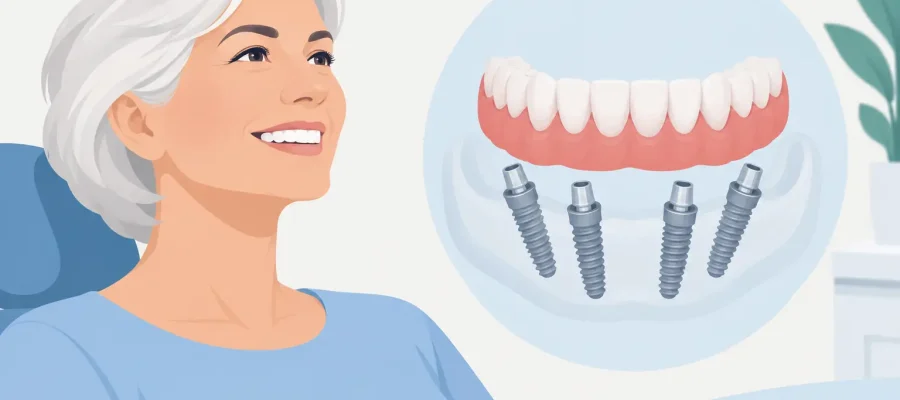
A full smile is not simply about having teeth again. It is about speaking without covering your mouth, enjoying dinner without worrying about a denture moving, and seeing a confident version of yourself in photos. So, can all-on-4 replace all missing teeth? For many patients who have lost every tooth in one jaw, the answer is yes: All-on-4 can support a fixed, full-arch smile using just four strategically placed dental implants.
The key word is many. All-on-4 is a powerful full-mouth restoration option, but a predictable result depends on bone quality, gum health, bite forces, medical history, and careful digital planning. The right treatment should restore function and aesthetics without making promises your anatomy cannot support.
Can All-on-4 Replace All Missing Teeth in One Arch?
All-on-4 is designed to replace a complete upper or lower arch of missing teeth. Rather than placing one implant for every missing tooth, a surgeon places four implants in carefully selected areas of the jaw. A custom full-arch bridge is then secured to those implants.
This bridge commonly replaces 10 to 14 teeth, including the visible teeth that shape your smile and the back teeth needed for chewing. It stays in place and is not removed at night like a traditional denture. While it is not a set of individual natural teeth with individual roots, it can look, feel, and function much closer to a natural smile than a removable appliance.
If you are missing teeth in both the upper and lower jaw, you may need two separate All-on-4 restorations – four implants for the upper arch and four for the lower arch. That is often called full-mouth rehabilitation. Your treatment plan may also recommend All-on-6 for one or both arches when extra implant support would create a more stable long-term foundation.
Why Four Implants Can Support a Full Smile
The All-on-4 concept is based on strategic implant placement, not simply a smaller number of implants. The front implants are generally placed vertically, while the back implants are angled to use available bone more efficiently. This can reduce the need for bone grafting in suitable candidates, especially in areas where the jawbone has shrunk after years of tooth loss.
The implants act as anchors for the bridge. Once they integrate with the bone, they help distribute chewing forces across the arch. This approach also helps preserve the jawbone by giving it the stimulation it no longer receives from natural tooth roots.
That does not mean every patient can skip grafting. Severe bone loss, sinus position in the upper jaw, infection, or anatomical limitations may require additional procedures. A clinic should identify these factors before treatment begins, using 3D imaging rather than guessing from a standard X-ray alone.
What Your New Teeth Can Look Like
A full-arch bridge can be designed to be highly aesthetic, not merely functional. Shape, brightness, gum display, lip support, and facial proportions all affect whether the final smile looks natural on you. For patients who have worn dentures or lived with failing teeth for years, restoring this support can create a noticeable facial change.
The process often begins with a provisional fixed bridge. This is the set of teeth you may receive shortly after implant placement if your implants achieve adequate stability and your clinical situation allows immediate loading. It lets you leave with fixed teeth while your implants heal.
After healing, the final bridge is created. Final materials vary by treatment plan and may include high-strength zirconia or a layered ceramic restoration. The provisional phase matters because it gives your dentist an opportunity to refine speech, bite, tooth length, and smile design before the definitive arch is made.
A beautiful result is never just about choosing the whitest shade. It is about making the teeth look balanced with your features, age, skin tone, and personality. The goal is a signature smile that looks intentional, polished, and believable.
Who Is a Strong Candidate for All-on-4?
All-on-4 may be an excellent option if you have no teeth in an arch, are about to lose most or all remaining teeth, or are tired of a loose removable denture. It can also suit patients with widespread decay, advanced periodontal disease, broken crowns, or failing older dental work when saving each individual tooth no longer offers a predictable outcome.
Healthy enough bone is needed to stabilize the implants, but this does not mean you need perfect bone volume. The angled placement used in All-on-4 can make treatment possible for patients who would otherwise expect extensive grafting. A 3D CBCT scan is essential for evaluating bone height, width, nerve locations, and sinus anatomy.
Medical factors matter as well. Uncontrolled diabetes, active gum infection, heavy smoking, untreated teeth grinding, and certain medications can affect healing and implant success. None of these automatically rule out treatment, but they may change the timeline, the type of restoration, or the level of support recommended.
Patients with strong bite forces or a history of grinding may benefit from six implants rather than four. Others may need a grafting procedure before implant placement. The best plan is not the fastest-looking plan on paper. It is the one that provides a stable foundation for the years ahead.
The All-on-4 Treatment Journey
A premium full-arch treatment should feel carefully engineered from the first consultation. Planning begins with photographs, digital scans, bite analysis, and 3D imaging. These records allow the clinical team to map implant positions and create a smile design that works with your face and function.
If failing teeth remain, they are removed as part of the surgical appointment when appropriate. The implants are placed, and a temporary fixed bridge may be attached the same day. This means many patients do not have to leave with a removable denture while they heal. However, same-day fixed teeth are not guaranteed for every case. Implant stability, bone condition, infection levels, and bite pressure determine whether immediate loading is safe.
During the healing period, you will follow a softer diet and attend review appointments as directed. The temporary teeth protect the implants and allow you to test your new smile in real life. Once healing is complete, the final bridge is crafted with refined strength, fit, and esthetics.
For international patients, the treatment timeline should be planned around clinical safety, not only flight dates. Some cases are completed in distinct visits, with a healing interval between surgery and final teeth. At DRGO Smile Clinic, digital planning and coordinated travel support are designed to make that process clearer, but the clinical sequence always comes first.
All-on-4 vs. Dentures, Individual Implants, and All-on-6
Traditional dentures remain the most affordable way to replace all missing teeth, but they rest on the gums and can shift during eating or speaking. They also do not prevent ongoing bone loss in the same way implants can. For some patients, a removable implant-retained overdenture is a practical middle ground, especially when a fixed bridge is not the right choice.
Replacing every missing tooth with an individual implant is possible in selected cases, but it is usually more complex, more expensive, and not necessary for a full arch. All-on-4 provides a fixed full-arch result with fewer implants and a shorter surgical pathway.
All-on-6 follows the same full-arch principle but uses six implants instead of four. More implants can offer added support and force distribution, particularly in the upper jaw, for patients with stronger chewing forces, or where bone anatomy allows it. All-on-6 is not automatically better. It is simply a different engineering choice based on your scan, bite, and long-term goals.
Living With All-on-4 Teeth
Fixed does not mean maintenance-free. Your new bridge needs daily cleaning beneath the arch, around the implant areas, and along the gumline. A water flosser, specialized implant floss or brushes, and professional hygiene visits are central to protecting the tissues around the implants.
You should also expect regular checkups. The bridge, bite, screws, gums, and implants need to be monitored over time. Avoid using your teeth to open packaging, and wear a night guard if grinding is a concern. With consistent maintenance and a well-designed restoration, All-on-4 can be a durable, life-changing solution.
The most valuable next step is a proper full-arch assessment with 3D imaging and a smile preview. It gives you a clear answer about whether four implants can support your future smile – and whether a different plan would serve you better.