


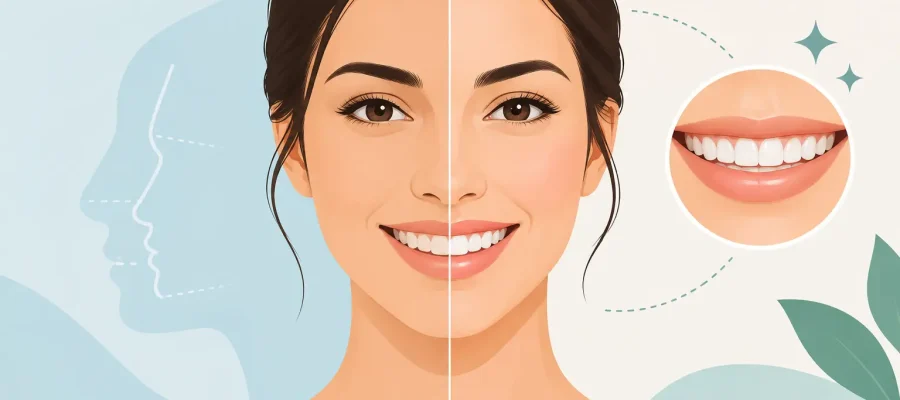
A smile can look technically beautiful and still feel slightly wrong for the face. Teeth that are too long, too bright, too square, or too wide can pull attention away from your natural features instead of supporting them. That is why the better question is not simply whether veneers look good. It is: can smile design improve facial balance? For the right patient, yes – when it is planned around facial proportions, lip movement, gum display, and bite function rather than a one-size-fits-all template.
A premium smile makeover should make people notice your confidence first. The teeth are the detail that brings the whole expression into focus.
Can Smile Design Improve Facial Balance? Yes, With Proper Planning
Facial balance is the relationship between the eyes, nose, lips, chin, jawline, and smile. Your teeth sit at the center of this composition. Their width, length, position, color, and visibility influence how the lower third of your face is perceived, especially in conversation, photographs, and video.
Smile design can improve this balance by creating teeth that complement your facial character. A person with stronger facial angles may suit a more defined tooth shape. Someone with softer features may look more natural with gently rounded edges. The goal is never to make every smile identical. It is to create a signature smile that looks intentional, refined, and believable on you.
It also depends on the starting point. Cosmetic dentistry can enhance the visual balance created by the smile, but it cannot change bone structure or correct every facial asymmetry. If the concern is driven by a major jaw discrepancy, skeletal bite issue, or significant facial muscle imbalance, orthodontic, surgical, or facial aesthetic treatment may be part of the conversation.
The Details That Change How Your Face Reads
A sophisticated smile design works through a series of small, connected decisions. Each one can affect the way your face appears at rest and in motion.
Tooth Length and Facial Proportion
Short, worn, or heavily chipped teeth can make the lower face appear compressed. Restoring appropriate length with veneers, crowns, or bonding can improve tooth display and bring more structure to the smile. In some cases, rebuilding worn teeth also helps restore lost bite height, which may support a more relaxed facial profile.
More length is not automatically better. Teeth that are made too long can look artificial, interfere with speech, or place unnecessary stress on the bite. The ideal length is determined by your lips, age, smile line, bite relationship, and how much tooth shows when you speak.
Tooth Shape, Width, and Symmetry
The upper front teeth are visual anchors. Their proportions can make a smile feel narrow, heavy, delicate, youthful, or mature. If they are overly square on a narrow face, the result can look harsh. If they are too narrow or rounded on a strong face, the smile may lack presence.
A custom design considers the ratio between tooth width and length, the curve of the incisal edges, and the gradual transition from the central teeth to the canines. Perfect symmetry is not always the target. Natural faces have subtle asymmetries, and a skilled design respects them while removing distractions such as uneven edges, irregular spacing, or a tilted smile line.
The Smile Line and Lip Support
The smile line is the relationship between the edges of the upper teeth and the curve of the lower lip. When these lines work together, the smile tends to look more harmonious and youthful. When the teeth appear flat, uneven, or hidden behind the lip, the face can lose energy in photos.
The position and thickness of restorations also matter. Veneers and crowns must be designed to support the lips appropriately without creating a bulky appearance. This is one reason rushed cosmetic work can disappoint: a bright new color alone cannot create facial harmony.
Gum Aesthetics and Tooth Exposure
Gums frame the teeth. Excess gum display, uneven gum levels, or a gummy smile can make teeth appear shorter than they are and disrupt the proportions of the smile. Gum contouring or other gum aesthetic procedures can reveal more tooth structure and create a cleaner, more balanced frame.
However, gum treatment should be based on diagnosis, not trends. A gummy smile may relate to gum position, tooth eruption, lip movement, or upper jaw anatomy. The right solution can range from precise gum reshaping to orthodontic treatment or carefully planned muscle-relaxing treatment in selected cases.
Why Digital Smile Design Matters Before Treatment
The difference between a standard cosmetic case and an engineered result is planning. Before teeth are prepared, a clinician should study your face from the front and side, your bite, your lip movement, and your smile in motion.
Digital Smile Design brings these records together through photographs, scans, video, and 3D planning. It allows the dental team to test proposed tooth shapes and proportions against your facial features before final restorations are made. For an international patient, this adds valuable clarity: you can see the direction of the transformation instead of choosing a shade or veneer style blindly.
At DRGO Smile Clinic, this process can be paired with digital workflows and a physical try-in, so adjustments can be discussed before the final E-Max veneers or zirconium crowns are placed. The preview is not a promise that every pixel will translate exactly to real life, but it creates a far more predictable starting point than choosing from generic before-and-after photos.
What Treatments May Be Part of a Balanced Smile Makeover?
The best treatment plan is determined by the condition of your teeth, gums, bite, and facial goals. For some patients, professional whitening and minimal composite bonding are enough. For others, veneers or crowns provide the control needed to change color, shape, spacing, and visible proportion.
E-Max veneers are often chosen when the natural teeth are healthy and the main goal is a highly aesthetic improvement with conservative preparation where suitable. Zirconium crowns may be more appropriate for teeth with larger restorations, structural weakness, or more demanding functional needs. If missing teeth or unstable dentures are affecting support and confidence, implant treatment, including full-arch solutions such as All-on-4 or All-on-6, may rebuild both function and the appearance of the smile.
Masseter Botox can be considered separately for patients with clenching-related muscle bulk or jaw tension, but it is not a substitute for dental planning. It changes muscle activity temporarily, while smile design changes the visual framework of the teeth and gums. Combining treatments only makes sense when each one addresses a clearly identified concern.
What Smile Design Cannot Do
Good cosmetic dentistry is powerful, but honest planning protects the result. Smile design cannot make an asymmetrical nose, chin, or jaw disappear. It cannot safely compensate for untreated gum disease, active decay, severe grinding, or an unstable bite. It should also never be used to place a bright, uniform set of teeth over a functional problem that needs treatment first.
There are trade-offs to discuss. Veneers and crowns require maintenance over time, and some cases require enamel preparation. Ultra-white shades may look striking under studio lighting but less natural in everyday settings. The fastest option is not always the most conservative option, particularly when orthodontics or gum stabilization would create a stronger long-term foundation.
A responsible consultation should cover these realities clearly. You should understand what will be changed, why it is being changed, how it will feel, and what future care may involve.
How to Know if You Are a Good Candidate
You may be a strong candidate for facially focused smile design if you feel your teeth look too small, worn, uneven, dark, narrow, overly prominent, or mismatched with your features. It can also be valuable if your smile disappears in photos, shows too much gum, or has changed after years of grinding, dental work, or tooth loss.
The first step is not selecting veneers. It is sharing high-quality photos, dental history, and your real goal. Do you want a softer smile? A more polished camera-ready look? Better lip support? Fixed teeth after tooth loss? Clear priorities help the clinical team design a result that fits your face and lifestyle rather than following a trend.
The most successful smile makeover does not ask your face to adapt to new teeth. It gives your natural features a more confident, harmonious frame – one that still looks like you when you laugh, speak, and walk into the room.