


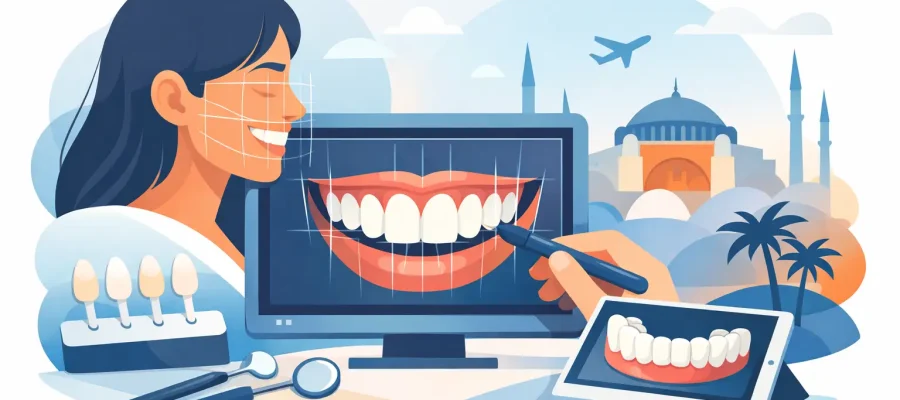
A smile makeover should not start with shaved teeth and crossed fingers. It should start with a plan you can actually see. That is why digital smile design in Turkey has become such a strong draw for international patients who want more than a generic cosmetic result. They want a smile engineered around their face, bite, proportions, and goals before treatment begins.
For patients flying in from the US and beyond, that level of visibility matters. You are not booking a routine cleaning. You are investing in veneers, crowns, implants, gum contouring, or a full Hollywood Smile, often on a tight travel schedule. Digital planning reduces guesswork, speeds up decisions, and gives you a clearer path from consultation to final result.
What digital smile design in Turkey actually means
Digital Smile Design, often shortened to DSD, is a planning method that uses photos, videos, scans, and facial analysis to map out your future smile. Instead of selecting tooth shapes from a brochure or making decisions chairside, the clinic builds a preview based on your facial features, lip movement, smile line, tooth display, and dental structure.
In practical terms, this means your dentist is not only looking at teeth. They are studying how your smile sits within your entire face. The width of the smile, the length of the front teeth, the gum line, the midline, and even how much tooth shows when you speak all influence the design.
In Turkey, this process is especially popular at high-volume cosmetic clinics because it fits the expectations of international patients. When someone is traveling for treatment, they want speed, but not at the expense of control. Digital smile design helps deliver both.
Why patients choose Turkey for digital smile design
Turkey has become a serious destination for aesthetic dentistry because the value equation is hard to ignore. Patients can access advanced cosmetic treatment, digital workflows, and experienced smile makeover teams at pricing that is often far more attractive than in the US or UK.
But price alone is not the real story. The stronger reason is efficiency. Many Turkish clinics are built around fast, coordinated treatment journeys. That includes in-house imaging, CAD/CAM production, same-day planning, and teams who handle consultation, treatment, and travel logistics in one system. For an international patient, that can mean fewer appointments, shorter stays, and far less friction.
The trade-off is that not every clinic advertising smile makeovers is operating at the same level. Some use the language of digital design loosely. A polished Instagram page is not the same thing as disciplined planning. If you are considering treatment abroad, the quality of the design process matters just as much as the quality of the final veneers or crowns.
How the process works from first contact to final smile
The journey usually starts remotely. You send photos, videos, and sometimes a panoramic X-ray or previous dental records. A preliminary consultation follows, where the clinic assesses whether you are a candidate for veneers, crowns, implants, whitening, gum reshaping, or a combined plan.
Once you arrive, the diagnostic phase becomes more precise. The clinic will typically take digital scans, high-resolution photos, bite records, and sometimes 3D imaging. These records are used to design your smile on screen, balancing aesthetics with bite function and long-term stability.
Step 1: Facial and dental analysis
This is where strong clinics separate themselves. A proper analysis looks beyond tooth color. It evaluates your face shape, lip support, smile symmetry, gum display, tooth proportions, and the relationship between upper and lower teeth. If you have worn teeth, crowding, missing teeth, or asymmetry, the design has to solve those issues, not hide them.
Step 2: Digital preview and treatment planning
The preview gives you a realistic sense of direction. Depending on the case, it may show the proposed tooth shape, length, alignment, and shade. This stage is also where material choices are discussed. For example, E-Max veneers can deliver exceptional translucency for front teeth, while zirconia may be preferred when more strength or fuller coverage is needed.
A good clinic will also tell you what the preview cannot promise. A digital design is a planning tool, not a magic filter. Final results depend on your oral health, bone support, enamel condition, bite forces, and the treatment selected.
Step 3: Mock-up or trial smile
In many cases, the design is transferred into a temporary mock-up so you can see the shape in your mouth before final restorations are made. This is one of the most valuable parts of the process. Photos on a screen are useful, but seeing your smile in motion is better. You can assess how it looks while talking, smiling naturally, and resting your lips.
Step 4: Preparation and final restorations
If veneers or crowns are part of the plan, the teeth may be minimally prepared depending on the case. Then the final restorations are fabricated and fitted. In clinics with advanced digital workflows, this can happen quickly, which is one reason Turkey appeals to event-driven patients who want visible change within a single trip.
Who is a good candidate for digital smile design in Turkey
This approach works especially well for patients who want a visible cosmetic upgrade and value predictability. It is ideal for people considering veneers, crowns, composite bonding, implant-supported restorations, whitening, or gum aesthetics as part of a smile makeover.
It is also useful for complex cases. If you have uneven gums, missing teeth, old dental work, or a collapsed bite from grinding, digital planning helps organize treatment in the right order. Sometimes the answer is not just veneers. You may need gum contouring first, orthodontic movement, bite rehabilitation, or implant treatment before the final smile is built.
That is where honesty matters. If a clinic pushes every patient toward the same package, walk away. A true signature smile is not copied from the last patient.
Cost, timing, and what affects the final price
One reason patients search for digital smile design in Turkey is cost clarity. In many cases, smile makeover treatment in Turkey is significantly lower than in the US, even when you factor in flights and accommodations. Still, there is no single flat price because the design itself is only one part of the case.
Your cost depends on how many teeth are being treated, which materials are used, whether you need implants or gum work, and how complex the bite correction is. Ten E-Max veneers, for example, are priced differently from a full-mouth zirconia rehabilitation or an All-on-6 implant case with fixed temporary teeth.
Timing also varies. Some cosmetic cases can move very fast, particularly when digital scanning and in-house production are available. More complex implant cases may require stages, healing time, or temporary restorations before the final smile is placed. If a clinic promises the exact same timeline for every patient, that is usually a sign the planning is too generic.
What to ask before you book
Ask who designs the case, not just who sells it. You want to know whether the cosmetic dentist, prosthodontic team, and lab are aligned from the start. Ask what records are taken, whether you will receive a mock-up, what materials are recommended for your specific case, and how bite function is checked before final placement.
You should also ask what happens if the digital plan changes after clinical examination. That is normal sometimes. A responsible clinic will explain why and show you the reasoning. Precision is not about sticking blindly to the first render. It is about adapting without losing the result.
For international patients, logistics matter too. Airport transfers, hotel coordination, interpreters, and tightly scheduled appointments can make the experience feel controlled rather than chaotic. Clinics like DRGO Smile Clinic have built their model around exactly that kind of managed journey, combining digital treatment planning with concierge-style support for travelers who want premium results without unnecessary stress.
The biggest advantage – confidence before commitment
The real power of digital smile design is not the software. It is confidence. You see the direction before irreversible work begins. You understand the shape, the style, the limitations, and the likely outcome. That makes better decisions possible.
And that is exactly why this treatment model fits Turkey so well. Patients are not flying in just to save money. They are coming for speed, visible transformation, and a more curated experience. When the clinic gets the planning right, the trip feels less like a gamble and more like a well-executed upgrade.
If you are considering a smile makeover abroad, look for a clinic that treats design as a clinical discipline, not a sales gimmick. The best smiles are not simply bright and straight. They look right on your face, feel comfortable in function, and still look like you – only sharper, fresher, and ready for the next room you walk into.