


A bright, camera-ready smile is not created by choosing the strongest material or the whitest shade. It comes from choosing the restoration that respects your natural teeth while delivering the look you want. Porcelain veneers vs zirconia crowns: which is better? For most patients, the answer depends on one clinical question: are you improving a healthy tooth, or rebuilding a tooth that needs full protection?
For an image-conscious smile makeover, that distinction matters. Veneers can create the ultra-natural translucency associated with a refined Hollywood Smile. Zirconia crowns can transform teeth that are worn, heavily restored, cracked, or structurally weak. Both can look exceptional when designed precisely. They are not interchangeable.
Porcelain Veneers vs Zirconia Crowns: The Real Difference
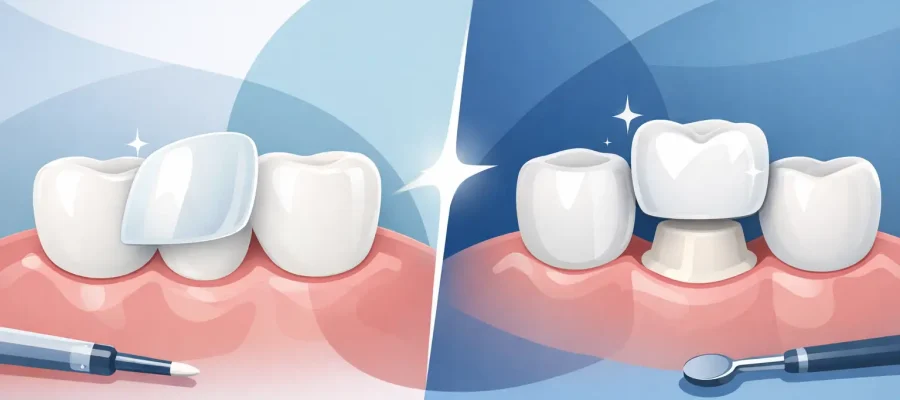
A porcelain veneer is a slim, custom-made shell bonded to the front surface of a tooth. It changes the visible color, shape, proportion, and surface character while preserving as much of the natural tooth as possible. High-quality ceramic veneers, including E-Max options, are designed for front-tooth aesthetics – the area where light reflection, translucency, and fine detail make a smile look either natural or artificial.
A zirconia crown covers the entire tooth, including the front, back, and biting surface. It is used when a tooth needs more than a cosmetic upgrade. A crown restores strength as well as appearance, making it a strong option for teeth with large fillings, deep cracks, major wear, root canal treatment, or previous restorations that have failed.
The better choice is not the one that sounds more premium. It is the one that gives you the best long-term result with the least unnecessary alteration to healthy enamel.
When Porcelain Veneers Are the Better Choice
Porcelain veneers are often the first choice when front teeth are fundamentally healthy but visually distracting. Think stubborn discoloration that whitening cannot correct, small gaps, uneven edges, mild crowding, short teeth, or shapes that do not match the rest of your face.
Their greatest advantage is conservative preparation. In suitable cases, the dentist removes only a small amount of enamel to create room for the ceramic. This allows the veneer to sit naturally rather than looking bulky. Because veneers bond strongly to enamel, they can be highly durable when bite forces are managed correctly.
Aesthetic control is another major advantage. Veneer ceramics can be layered and characterized to mimic the subtle behavior of natural enamel. The result can be bright without looking flat, polished without looking plastic, and symmetrical without erasing personality from the smile.
Veneers do have limits. They are not a shortcut for teeth weakened by extensive decay, large old fillings, severe grinding damage, or fractures that extend around the tooth. Placing a veneer on a tooth that truly needs a crown may produce a beautiful immediate result but a less predictable one over time.
When Zirconia Crowns Are the Better Choice
Zirconia crowns are built for structural confidence. Zirconium dioxide is a highly durable ceramic that performs especially well in patients with strong bites, clenching habits, extensive tooth wear, or teeth that have already lost a significant amount of natural structure.
A crown is often the smarter choice when the tooth has a large filling, has received root canal treatment, has visible cracking, or needs to be rebuilt to support a stable bite. Since it wraps around the tooth, it redistributes force more effectively than a veneer. This can protect what remains of the natural tooth and reduce the chance of a future fracture.
Modern zirconia is not limited to the opaque, overly uniform crowns many patients remember. Premium multilayer zirconia can be carefully selected and customized for beautiful smile-zone results. Still, zirconia generally does not replicate the light translucency of fine porcelain as closely as an E-Max veneer does. For a highly visible front tooth with healthy enamel, that difference can matter.
Zirconia crowns typically require more tooth preparation because the material needs space around the entire tooth. That is appropriate when full coverage is clinically necessary. It is not ideal when a minimal-prep veneer can safely achieve the same aesthetic goal.
Compare Veneers and Zirconia Crowns Before You Commit
Appearance and smile design
For pure cosmetic refinement on healthy front teeth, porcelain veneers usually offer the most lifelike result. They allow the dentist to control incisal translucency, texture, brightness, and tiny asymmetries that make a smile feel naturally yours.
Zirconia crowns can also look excellent, particularly when designed as part of a full smile restoration. They are often preferred when appearance must be paired with a significant structural rebuild. Material selection, shade mapping, gum symmetry, and facial proportions matter more than choosing a material by name alone.
Tooth preservation
Veneers are generally the more conservative option because they cover only the visible surface and often require less enamel removal. When the tooth is healthy enough for a veneer, preserving enamel is usually a priority.
Crowns require more reduction because they cover every surface. That trade-off is justified when a tooth is compromised. A properly planned crown protects a vulnerable tooth; an unnecessary crown removes more natural structure than the situation calls for.
Strength and bite resistance
Zirconia wins on raw strength. It is an excellent choice for back teeth and for patients who grind or clench, especially when a night guard is also part of the long-term plan.
Porcelain veneers are durable but are designed for a different job. They perform best when bonded to healthy enamel and when the bite is balanced. If you regularly bite pens, chew ice, or use your front teeth to open packaging, either restoration can chip or fail.
Longevity and maintenance
Both veneers and zirconia crowns can last many years with excellent hygiene, regular professional care, and a stable bite. Longevity is not just a material question. It also depends on preparation quality, bonding or cementation technique, gum health, bite design, and the habits you bring home after treatment.
Neither option is maintenance-free. You should brush, floss, attend regular cleanings, and wear a custom night guard if you clench or grind. Cosmetic dentistry works best when it is treated as a long-term investment, not a temporary photo filter.
Which Treatment Fits Your Smile?
Veneers may be the better fit if your teeth are healthy and you want to correct color, spacing, minor alignment concerns, or shape with the most enamel-preserving approach. They are particularly effective for patients planning a polished, high-definition smile makeover for a wedding, public-facing career, content creation, or a major life milestone.
Zirconia crowns may be the better fit if your teeth are heavily filled, weak, worn, fractured, or already crowned. They are also a practical choice when rebuilding bite height or restoring teeth after major damage. In many full-mouth cases, the best plan is not veneers or crowns. It is a carefully designed combination, with veneers on healthy visible teeth and zirconia crowns where full protection is necessary.
This is why a one-size-fits-all “Hollywood Smile package” is not enough. The best treatment plan assigns the right restoration to each individual tooth.
Start With a Digital Smile Preview, Not a Material Guess
Before any tooth is prepared, you should be able to see and discuss the proposed direction of your smile. Digital Smile Design allows the team to assess facial balance, tooth proportions, lip movement, gum line, bite relationship, and the level of brightness that will look refined rather than overdone.
At DRGO Smile Clinic, this planning phase is used to turn a smile goal into a clinically sound treatment plan. Your dentist can identify which teeth are suitable for conservative veneers, which need zirconia coverage, and whether gum contouring, whitening, or bite correction should happen first. A mock-up or try-in gives you an opportunity to evaluate the shape and character before final placement.
For international patients, this precision also makes the timeline more predictable. Depending on your case, digital workflows and CAD/CAM technology can help streamline crown production and fitting. Veneer and full-smile cases still require enough time for planning, preparation, try-in, adjustments, and final bonding – because the fastest result is only valuable when it is right.
The right question is not, “Which material is better?” Ask which restoration lets you keep the most healthy tooth while delivering the confidence, strength, and signature smile you expect. That is where a lasting transformation begins.