


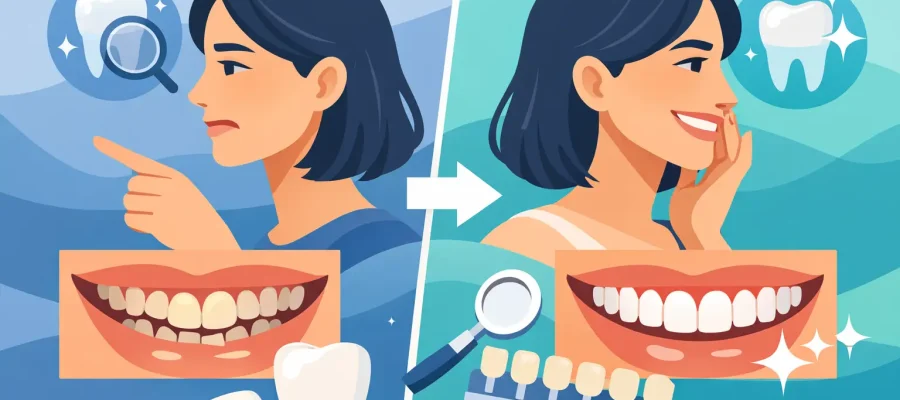
A bright, straight smile can look dramatic in photos, but the real question serious patients ask is simpler: what exactly changed between the before and after? When people search for smile makeover before after examples, they are usually not looking for inspiration alone. They want proof, pattern recognition, and a clearer sense of what result is realistically possible for their own face, teeth, and timeline.
That is the right way to look at cosmetic dentistry. A strong transformation is not just whiter teeth. It is a controlled change in shape, proportion, alignment, gum display, and facial balance. The best before-and-after cases look effortless because the planning was disciplined.
What smile makeover before after examples actually show
Most patients notice color first. Teeth look brighter, cleaner, and more uniform in the after photo. But color is often the least sophisticated part of the result. The bigger difference usually comes from edge design, symmetry, tooth width, correction of worn surfaces, and the way the smile follows the lower lip.
A quality before-and-after example should show whether the dentist corrected crowding, closed spaces, reduced a gummy appearance, restored chipped teeth, or rebuilt a bite damaged by grinding. It should also reveal whether the final smile suits the patient’s age, facial features, and personality. A smile that looks perfect on a screen can still look wrong in real life if it is too bulky, too opaque, or too uniform.
This is why polished photos alone are not enough. The useful examples are the ones that help you understand the treatment logic behind the transformation.
The most common types of before-and-after smile changes
Veneers for shape, color, and front-tooth symmetry
Veneer cases often create the most striking cosmetic changes in the shortest visible time. In a typical before image, the patient may have small gaps, uneven edges, stains that do not respond to whitening, or teeth that appear short or worn. In the after image, the teeth look brighter and more balanced, with cleaner line angles and a more refined overall smile frame.
The trade-off is that veneers are not a one-size-fits-all solution. Patients with heavy grinding, active gum disease, or major bite problems may need a more protective or comprehensive plan first. The best veneer transformations preserve a natural look rather than chasing an overly flat, artificial white.
Zirconium crowns for larger structural correction
Before-and-after examples involving zirconium crowns are often more extensive. These cases usually start with damaged fillings, broken teeth, older crowns, severe discoloration, or shape issues across multiple teeth. The after result tends to look stronger and more uniform, especially when the goal is both beauty and durability.
Crowns can be the right option when veneers would be too conservative to solve the problem fully. That said, the planning matters even more because the teeth need greater preparation. In expert hands, the outcome can look elegant and highly natural. In rushed hands, it can look oversized and generic.
Whitening for simple but limited improvement
Some of the most honest smile makeover before after examples are the least dramatic. Whitening can refresh the entire smile when the teeth already have good shape and alignment. The before image may show yellowing from coffee, wine, smoking, or age. The after image shows a cleaner, healthier look without changing the tooth structure.
This option is effective, but only when the underlying smile is already working. Whitening will not fix worn edges, spacing, crowding, or mismatched restorations. Patients sometimes expect a veneer-level result from whitening alone, and that is where disappointment starts.
Gum contouring for better proportions
In some examples, the teeth are not the problem at all. The issue is excessive gum display or uneven gum levels. Before photos may show short-looking front teeth or an unbalanced smile line. After gum contouring, the teeth appear longer, more symmetrical, and more expensive-looking without necessarily changing the enamel much.
This kind of refinement is easy to underestimate until you see a well-documented case. Often it is the difference between a smile that looks improved and one that looks fully designed.
Implants and full-arch solutions for complete rehabilitation
The most life-changing before-and-after transformations are usually implant cases. A patient may begin with missing teeth, failing bridges, advanced decay, or removable dentures. The after result is not only cosmetic. It restores fixed function, confidence in speech, and normal day-to-day comfort.
For full-arch patients, the visual impact is major, but the real value is stability. Procedures such as All-on-4 or All-on-6 can create a fixed smile immediately in the right case, though not every patient qualifies for the exact same-day pathway. Bone quality, infection, bite forces, and medical history all influence the plan.
How to read before-and-after photos like a serious buyer
The smartest patients do not ask only, “Does this look good?” They ask, “Would this result make sense for me?” That shift matters.
Look first at the starting point. Was the case mild staining, or was it a complex rebuild? A dramatic after photo means little if the before photo was already easy. Then look at tooth proportion. Natural smiles usually have slight variation, softness at the edges, and a brightness that fits the person’s skin tone and age. If every case looks identical, the clinic may be selling a template rather than a design process.
You should also pay attention to the gums, not just the teeth. Healthy tissue frames the smile. Redness, swelling, or poorly adapted margins can hide behind bright lighting and still signal rushed work.
Finally, ask whether the example reflects one treatment or several. Many of the best transformations are layered – for example, whitening plus gum contouring, or implants plus crowns, or veneers guided by digital planning. Knowing the combination helps you understand both cost and timeline.
Why digital planning changes the after result
The difference between a pleasant improvement and a signature smile often happens before treatment begins. Digital Smile Design, 3D previews, and CAD/CAM workflows allow the dentist to engineer proportions before the final restorations are made. For international patients especially, this matters because travel-based dentistry needs precision, speed, and fewer surprises.
A digital plan can show how longer central incisors will affect the smile arc, how broader teeth will change facial balance, or whether a brighter shade still looks credible. It does not replace clinical judgment, but it improves predictability. That is one reason advanced clinics can move faster without making the process feel careless.
At DRGO Smile Clinic, this planning-first model is central to the patient journey because premium results depend on control, not guesswork. The visual preview gives patients confidence before they commit, especially when they are traveling for treatment on a fixed schedule.
What realistic timelines look like
Patients comparing smile makeover before after examples often assume every transformation happens in a single visit. Sometimes it does. Sometimes it should not.
Whitening and minor bonding can be quick. Veneers or crowns may be completed in a short travel window when the workflow is streamlined and the case is well selected. Same-day crowns and immediate smile makeovers are possible in advanced clinics using in-house digital systems. But more complex implant or full-mouth cases may need staged treatment, healing time, or temporary restorations before the final result.
A trustworthy plan matches speed to biology. Fast is attractive. Predictable is better.
What makes one after photo better than another
The best smile does not simply look white and straight. It looks integrated. The tooth shapes match the face. The midline feels balanced. The incisal edges are lively rather than flat. The patient looks more polished, not less natural.
This is especially important for professionals, creators, and event-driven patients who are often on camera or in close-contact settings. An overdone smile can be as distracting as a neglected one. Good cosmetic dentistry creates presence without obvious effort.
That is why the strongest before-and-after examples are not always the most extreme. They are the cases where the change looks inevitable, as if the patient was always supposed to have that smile.
If you are evaluating your options, use before-and-after examples as a decision tool, not just visual proof. Look for planning, proportion, and realism. The right smile makeover should feel like a precise upgrade to your identity, not a replacement of it.