


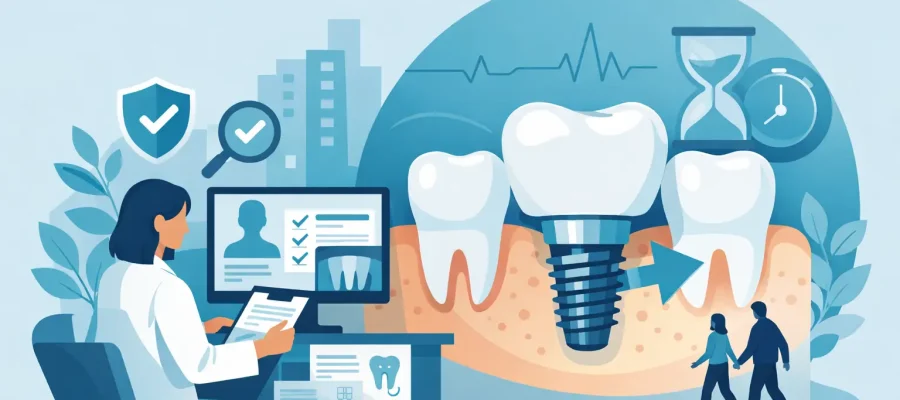
Losing a tooth does not automatically mean you are ready for an implant tomorrow – but it also does not mean you are disqualified. If you are researching how to qualify for implants, the real question is whether your bone, gums, bite, and overall health can support a secure, long-lasting result. That answer comes from planning, not guesswork.
For many patients, the surprise is this: implant candidacy is broader than they expected. You do not need perfect oral health when you start. You need the right treatment plan. Some people qualify immediately for a straightforward implant. Others qualify after preparation such as gum treatment, bone grafting, or a sinus lift. The difference matters, especially if you are traveling for treatment and want a plan that is efficient, predictable, and worth the trip.
What dentists look at to qualify for implants
A dental implant is a titanium post placed in the jawbone to replace a missing tooth root. For it to work well, the implant needs enough healthy bone for stability, healthy gum tissue around it, and a bite that will not overload the final tooth. That is why qualification is never based on one factor alone.
The first concern is bone volume and bone quality. If the jaw has shrunk after a tooth was lost, the implant may still be possible, but the site may need augmentation first. The second concern is gum health. Active periodontal disease can compromise healing and long-term success. The third is your medical profile, including diabetes control, smoking habits, medications, and any condition that affects healing. Finally, your dentist looks at the design of the final restoration. A beautiful implant result is not just about placing a screw in bone. It is about creating a tooth or full-arch smile that functions well and looks natural.
How to qualify for implants: the main criteria
If you want a direct answer on how to qualify for implants, start with these essentials. You need enough jaw support for placement, healthy or treatable gums, and a medical profile that allows normal healing. You also need realistic timing. Some cases can move fast with immediate implants or fixed full-arch solutions, while others need staged treatment.
Age is usually less important than people think. Adults with fully developed jaws can often be considered, while bone condition matters far more than being in your 40s, 60s, or 70s. Many older patients are excellent candidates. On the other hand, younger adults with advanced gum disease or heavy smoking habits may need more preparation.
Tooth loss pattern also changes the plan. A single missing tooth is different from a full-arch restoration. With one implant, the dentist evaluates a very specific site. With All-on-4 or All-on-6, the assessment expands to full-jaw anatomy, bite force, smile line, and the condition of any remaining teeth.
Bone density and bone volume
Bone is one of the biggest gatekeepers. When a tooth has been missing for a while, the jaw in that area can resorb. If enough bone remains, implant placement may be simple. If not, a bone graft may be needed to build support. In the upper back jaw, the sinus can reduce available bone height, which is why some patients need a sinus lift before implants.
This is exactly where advanced imaging matters. A 3D scan shows whether you qualify now, qualify after preparation, or would benefit from a different approach entirely. For international patients, this kind of planning is especially valuable because it reduces uncertainty before travel.
Gum health and infection control
Healthy gums create the environment implants need. If there is active infection, untreated periodontal disease, or deep pockets around neighboring teeth, those issues should be addressed first. This does not automatically rule you out. It simply means qualification may be conditional on cleaning up the foundation.
If a tooth is failing because of infection, extraction and implant timing depend on how much bone is preserved and whether the site can be stabilized. In some cases, immediate implant placement is possible. In others, short healing time produces a safer and more esthetic result.
Medical history and healing ability
Most common medical conditions do not instantly eliminate implant treatment, but they do affect the plan. Well-controlled diabetes is often compatible with implants. Poorly controlled diabetes raises healing risks. Smoking is another major factor. Smokers can still receive implants, but the risk of complications and failure is higher, especially with heavy use.
Certain medications and conditions require closer review. Blood thinners, osteoporosis drugs, autoimmune conditions, and radiation history may influence timing or surgical technique. A serious implant clinic looks at this carefully because speed only matters if the result is stable.
The tests that determine if you qualify
You cannot reliably self-diagnose implant candidacy from photos or symptoms alone. A real qualification process usually includes a clinical exam, digital X-rays, and often a CBCT scan for 3D analysis. This shows bone height, width, nerve location, sinus anatomy, and any hidden pathology.
Photos, bite records, and smile analysis may also be part of the workup, especially when the result must be both functional and high-end esthetic. If the front teeth are involved, tiny details matter. Implant position affects gum symmetry, tooth shape, and how natural the final smile looks in conversation, on camera, and in close-up photos.
For patients considering treatment abroad, remote pre-assessment can help narrow the likely plan before arrival. Existing scans, panoramic X-rays, and intraoral photos often give the team enough information to discuss whether you appear to be a straightforward candidate or a likely grafting case. Final qualification still happens after in-person examination, but early review makes the journey more efficient.
Reasons you may not qualify right away
Not qualifying today is not the same as not qualifying at all. The most common reasons for delay are bone loss, untreated gum disease, active infection, uncontrolled medical conditions, and smoking patterns that create elevated risk. Sometimes the issue is mechanical rather than biological. If your bite is highly destructive from clenching or grinding, the implant plan may need reinforcement, bite adjustment, or a protective night guard.
Another factor is expectation. Some patients want one-trip perfection in a case that needs staged healing for the best cosmetic result. A premium outcome sometimes means accepting the right sequence instead of forcing the fastest one.
What can improve your chances of qualifying
If you are serious about moving forward, a few actions can materially improve candidacy. Stop smoking or reduce it sharply before surgery. Treat gum inflammation early. Replace missing teeth sooner rather than later if possible, because waiting often increases bone loss. Keep medical conditions controlled and bring a full medication list to your consultation.
Oral hygiene matters more than many patients expect. Implants are not immune to plaque and inflammation. Dentists want to see that you can maintain the investment. A stunning final smile is built on daily care, not just surgical precision.
Single implants vs full-arch cases
The qualification process changes based on the kind of result you want. A single implant usually depends on one local site being suitable. A full-arch case can sometimes help patients who are actually poor candidates for multiple separate implants, because angled implants and strategic placement may avoid weaker areas of bone.
This is why full-arch solutions can be appealing for patients with widespread tooth loss, failing bridges, or advanced breakdown. In selected cases, fixed teeth can be delivered immediately after implant surgery, giving you function and confidence much faster than traditional staged treatment. At DRGO Smile Clinic, this level of speed only works because planning is disciplined and digitally guided.
The smartest next step if you want implants
If you are asking how to qualify for implants, do not think in terms of pass or fail. Think in terms of condition, preparation, and design. The right clinic will tell you whether you are ready now, what needs to be improved first, and which timeline gives you the strongest blend of aesthetics, comfort, and long-term success.
That is the shift that makes implant treatment feel clear instead of intimidating. You are not chasing a maybe. You are building a plan around your anatomy, your health, and the result you want to wear every day.