


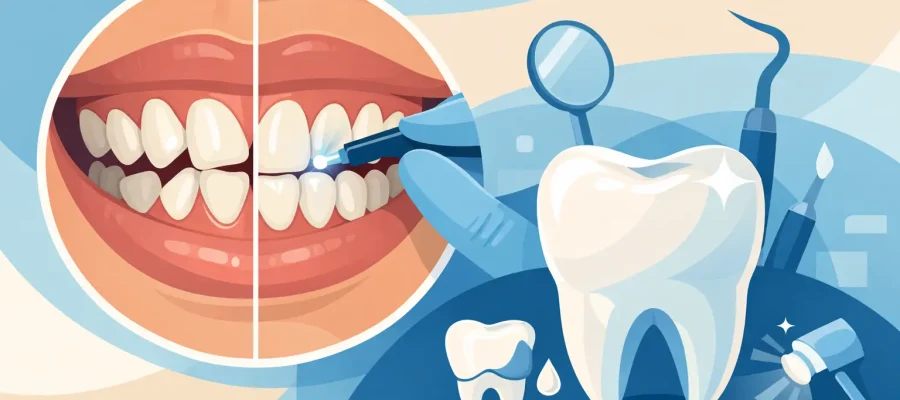
You do not need severely misaligned teeth to feel bothered by your smile. For many adults, the issue is smaller but still visible – one tooth that overlaps, slight crowding in the front, or a tooth that turns just enough to catch the light in photos. That is usually when dental bonding for crooked teeth enters the conversation.
Bonding can make a smile look straighter without braces or aligners, and that is exactly why patients ask about it. It is fast, conservative, and far more affordable than many full cosmetic treatments. But it is not a magic fix for every kind of crookedness. The real question is not whether bonding can help. It is whether it can deliver the level of symmetry, durability, and polish you actually want.
What dental bonding for crooked teeth can actually do
Dental bonding uses tooth-colored composite resin to reshape the visible surfaces of teeth. A cosmetic dentist adds material strategically, then sculpts, smooths, and polishes it so the teeth appear more even. When a tooth is slightly rotated, shorter than the others, or set back just enough to create a shadow line, bonding can visually correct the imbalance.
This matters because the eye does not measure alignment the way an orthodontist does. It reads line, width, proportion, and light reflection. If those elements are improved, a smile can appear dramatically straighter even when the actual tooth positions have not moved.
That makes bonding a useful option for mild cosmetic concerns. It works especially well for small overlaps, uneven edges, narrow teeth, triangular spaces, and minor asymmetry in the front teeth. In the right case, the improvement is immediate.
When bonding is a smart choice
Bonding tends to work best when the crooked appearance is visual rather than structural. If a tooth is slightly tucked behind another, resin can sometimes be added to neighboring teeth to create a cleaner line. If one lateral incisor looks twisted because of shape rather than true position, bonding may be enough to balance it.
It is also attractive for patients who want minimal preparation. In many cases, little to no enamel removal is needed. That makes the treatment less invasive than veneers or crowns. For patients testing a new smile design, or those who want improvement before a wedding, shoot, or major event, speed is a major advantage.
Another reason patients choose bonding is flexibility. Composite can be adjusted, repaired, and refined over time. That can be helpful if you are making small aesthetic upgrades rather than committing to a full smile makeover in one step.
Where dental bonding for crooked teeth falls short
Bonding has limits, and this is where honest planning matters. If teeth are significantly crowded, protruding, or rotated, resin can only disguise so much. In fact, trying to mask more severe crookedness with bonding can make teeth look bulkier. Instead of creating a cleaner smile, it may create a heavier one.
There is also a durability trade-off. Composite resin is strong, but it is not as stain-resistant or long-lasting as ceramic. Patients who drink a lot of coffee, tea, or red wine, or who grind their teeth, may notice wear and discoloration sooner than they expect. Touch-ups are common over the years.
Precision is another factor. Bonding is highly technique-sensitive. Small changes in contour, texture, and polish affect whether the result looks naturally straight or obviously added. For image-conscious patients, that distinction matters.
Bonding vs orthodontics
Orthodontics moves teeth. Bonding hides misalignment visually. That is the cleanest way to understand the difference.
If your bite is functional, your crowding is minor, and your goal is cosmetic improvement in the smile zone, bonding may be enough. If your teeth are actually out of position in a way that affects bite, hygiene, or long-term wear, orthodontics usually makes more sense.
There is also the issue of facial harmony. Straight-looking front teeth are one part of an attractive smile, but they need to work with the bite and lip line too. Some patients want the fastest route to a better smile, while others want the most structurally ideal correction. Neither approach is wrong. It depends on your timeline, budget, and expectations.
For many adults, the answer is a combination. Minor alignment may be improved with short-term clear aligners first, followed by bonding or veneers for final refinement. That often creates a better long-term result than using one treatment to do everything.
Bonding vs veneers
Patients often compare bonding with veneers because both can create the appearance of straighter teeth. The difference is in material, longevity, and the level of finish.
Bonding is quicker and more conservative. Veneers are more engineered. Porcelain veneers offer superior color stability, edge definition, and light reflection, which is why they are often chosen for high-visibility smile transformations. They also hold their polish longer.
If you only need a subtle correction on one or two teeth, bonding can be the smarter choice. If you want a more dramatic, highly symmetrical smile with better stain resistance and longevity, veneers are often the stronger investment.
This is where digital planning changes the conversation. With advanced smile design, patients can preview tooth proportions, smile width, and alignment effect before treatment starts. That level of planning helps determine whether bonding will be enough or whether a ceramic solution will deliver a cleaner result.
What the treatment process looks like
The process is usually straightforward, but the planning stage should never feel rushed. A skilled cosmetic dentist begins by evaluating tooth position, bite, smile line, and facial proportions. Photos and digital previews can be especially useful when the goal is not just to repair a tooth, but to reshape how the entire smile reads.
Once the plan is approved, the tooth surface is prepared lightly so the resin can bond properly. The composite is then layered and sculpted by hand. This is the artistic part of the procedure, but it still relies on clinical precision. The dentist adjusts shape, length, and contour carefully so the corrected tooth blends with the others.
After shaping, the material is hardened with a curing light, then refined and polished. In many mild cases, treatment can be completed in a single visit. That speed is one reason cosmetic patients find bonding appealing.
Who is a good candidate
The best candidate for bonding has healthy teeth and gums, mild visible crookedness, and realistic expectations. If the main concern is a small aesthetic flaw in the front teeth, bonding can be very effective.
Patients who want perfection at every angle should pause and assess their priorities. Bonding can look excellent, but it is not always the ideal solution for patients seeking the ultra-symmetrical finish associated with a full premium smile makeover. In those cases, porcelain restorations may offer more control.
Lifestyle matters too. If you bite your nails, clench heavily, or frequently use your front teeth to open packaging, bonding may chip faster. Maintenance is part of the deal.
How long results last
Bonding can last several years, but longevity depends on placement, habits, and material quality. Front-edge bonding on someone with a heavy bite may need maintenance sooner than bonding placed for small contour correction. Polishing and occasional repair are normal.
The upside is that adjustments are usually simpler than replacing a ceramic restoration. The downside is that the finish may not stay as pristine for as long. Patients choosing bonding should view it as a practical cosmetic enhancement, not always a forever solution.
At a clinic focused on engineered smile design, this is discussed upfront. The best cosmetic decisions are not based on the cheapest or fastest treatment alone. They are based on how well the treatment matches the result you want to wear every day.
The real decision: camouflage or correction?
That is the decision behind most consultations for crooked teeth. Do you want to visually improve the smile fast, or do you want to physically move teeth into better positions? Bonding is excellent for camouflage when the case is mild and the dentist has a strong aesthetic eye. It is less convincing when used to force a cosmetic shortcut on a problem that needs structural correction.
For international patients considering treatment as part of a focused smile trip, that distinction becomes even more important. Speed is valuable, but predictability matters more. At DRGO Smile Clinic, treatment planning is built around that principle – choosing the option that creates a cleaner, more stable, more camera-ready result rather than simply the fastest possible fix.
If your crooked teeth are mild, bonding may be the elegant answer. If they are not, the smartest move is not to push bonding beyond its limits, but to choose the treatment that gives your smile the finish it deserves.