


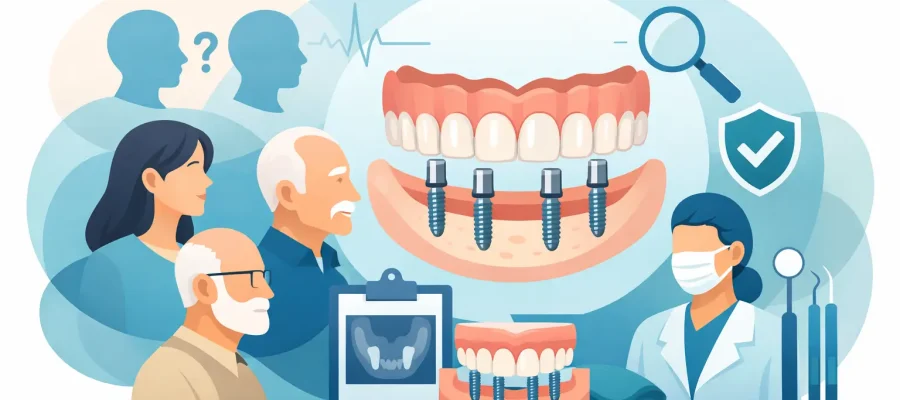
Losing most or all of your teeth changes more than what you eat. It can affect the way you speak, smile in photos, and show up in rooms that matter. If you are asking who is a candidate for All-on-4?, the short answer is this: many people with failing, missing, or uncomfortable teeth may qualify for a fixed full-arch solution, even when they have been told they do not have enough bone for traditional implants.
All-on-4 is designed to replace an entire upper or lower arch with a secure, implant-supported bridge. Rather than placing an implant for every missing tooth, a surgeon places four strategic implants in areas of the jaw with the strongest available bone. The back implants are often angled to maximize support and reduce the need for bone grafting. For the right patient, this approach can make fixed teeth immediately possible.
The right answer is never based on a photograph or a quick message alone. A detailed assessment of your bone, gums, bite, medical history, and smile goals is what turns a promising option into a predictable treatment plan.
Who Is a Candidate for All-on-4 Treatment?
The strongest candidates are adults who have lost most or all teeth in one arch, or who are close to losing them because of advanced decay, gum disease, repeated fractures, or failing dental work. Many patients still have teeth when they begin the process. If those teeth cannot be restored predictably, removing them and replacing the full arch with fixed implant teeth can be healthier and more efficient than years of patchwork treatment.
All-on-4 may also suit people who currently wear removable dentures but are tired of movement, sore spots, adhesive, and dietary limits. A well-planned fixed bridge does not come out at night, and it can provide the stability needed to eat, speak, and smile with greater confidence.
Age alone does not decide eligibility. A healthy 70-year-old with controlled medical conditions may be a better implant candidate than a younger patient with uncontrolled diabetes, heavy smoking habits, or untreated gum infection. The deciding factor is whether the mouth and body can support healing and long-term implant success.
You have widespread tooth loss or failing teeth
All-on-4 is not usually the first choice for one missing tooth or a small gap. A single implant, bridge, or limited implant restoration may be more conservative when neighboring teeth are healthy. Full-arch treatment becomes more appropriate when the majority of teeth are already missing, severely damaged, loose from gum disease, or covered by failing crowns and bridges.
Patients with extensive dental problems often want one complete plan rather than a cycle of emergency visits. All-on-4 can consolidate treatment into a definitive solution, replacing compromised teeth with a full, coordinated smile designed around facial balance, bite function, and natural-looking tooth proportions.
You want fixed teeth rather than a removable denture
A major reason patients consider All-on-4 is the desire for stability. Traditional dentures rest on the gums and can shift under pressure. Implant-supported full-arch teeth are anchored to the jaw, creating a more secure feel during daily life.
That does not mean All-on-4 is maintenance-free. The bridge must be cleaned carefully around the implants, professional reviews remain essential, and a protective night guard may be recommended for patients who clench or grind. The benefit is not zero responsibility. It is a more stable, fixed foundation for function and confidence.
You have enough usable jawbone – even if bone loss exists
Bone loss is common after teeth have been missing for years. It is also one of the reasons people assume implants are out of reach. In many cases, All-on-4 is specifically helpful because it uses the denser bone toward the front of the jaw and angles the posterior implants for support.
Still, every jaw is different. A 3D CBCT scan is needed to assess bone volume, density, sinus position in the upper jaw, nerve location in the lower jaw, and the safest implant positions. Some patients can avoid grafting. Others may need bone grafting, a sinus lift, additional implants, or a different treatment approach before fixed teeth can be placed safely.
Health Factors That Shape All-on-4 Eligibility
A premium result begins with clinical honesty. Being interested in All-on-4 does not automatically mean immediate surgery is the right move. Your health profile must support predictable healing.
Controlled diabetes, high blood pressure, osteoporosis, and many other health conditions do not automatically rule out dental implants. Your dental team will review your medical history, medications, and recent health status. The goal is to identify risks early and coordinate care appropriately when needed.
Smoking and nicotine use deserve a direct conversation. Nicotine restricts blood flow and can interfere with healing, increasing the risk of implant complications. Patients who smoke may still be considered in selected cases, but reducing or stopping nicotine use before and after surgery can materially improve the outlook.
Active gum disease and oral infection must also be addressed. If remaining teeth are infected or gums are inflamed, that condition becomes part of the surgical plan. Diseased teeth may be removed, sites may be cleaned, and the bridge design may be adjusted to allow healthy healing. The objective is not simply to place implants quickly. It is to create a stable environment for them to last.
When Immediate Teeth Are Possible – and When They Are Not
Many All-on-4 patients can receive a fixed temporary bridge shortly after implant placement. This is often called immediate loading. It means you can leave surgery with teeth rather than waiting months without a smile.
Immediate teeth are not identical to the final bridge. The temporary restoration is designed to protect healing implants while giving you a presentable, functional smile. During this phase, a soft-food diet and careful instructions are essential. Excess pressure while the implants are integrating can compromise the result.
Whether immediate loading is appropriate depends on implant stability at surgery, bone quality, bite forces, infection levels, and the complexity of your case. If the implants do not achieve the required stability, a staged plan may be safer. That can feel disappointing in the moment, but it is the right trade-off when long-term success is the priority.
After healing, the final full-arch bridge is designed with greater precision for color, tooth shape, gum contours, speech, bite, and facial aesthetics. This is where a functional rehabilitation becomes a signature smile.
All-on-4 vs. All-on-6: Which Is Better?
Four implants can provide excellent support for a full arch in properly selected cases. All-on-6 uses six implants instead, offering more points of support where anatomy and bone availability allow. Neither option is automatically better for every patient.
All-on-6 may be recommended when there is sufficient bone and the treatment team wants to distribute bite forces across more implants. All-on-4 may be the smarter choice when the anatomy supports four well-positioned implants but additional placement would offer no meaningful advantage. The best plan is based on your scan, bite, restoration material, and long-term force patterns – not on a one-size-fits-all package.
What a Proper All-on-4 Assessment Should Include
For international patients, clear planning before travel is especially valuable. Records such as recent X-rays, medical information, and photos can help begin the conversation remotely, but they do not replace an in-person examination and 3D scan.
At DRGO Smile Clinic, the planning process is built around surgical safety and visual predictability. The clinical team evaluates the jaw structure, remaining teeth, gum health, bite relationship, and smile line before recommending a path. Digital planning helps translate those findings into a restoration that looks refined while respecting the mechanics that keep it stable.
Your consultation should also cover the realities after treatment: the healing timeline, temporary versus final teeth, food restrictions, hygiene routine, possible grafting needs, and the number of visits required. A clinic that explains these details clearly is protecting both your investment and your result.
Who May Need a Different Approach?
Some people are not ready for All-on-4 immediately. Patients with uncontrolled medical conditions, untreated severe infection, very limited bone in key areas, or difficulty maintaining oral hygiene may need preparatory treatment or an alternative solution.
Others may have enough healthy teeth to benefit from a more conservative plan. Saving natural teeth is often worthwhile when their prognosis is genuinely good. The goal should never be to remove teeth simply because full-arch implants are available. It should be to choose the treatment that gives you the strongest combination of health, function, aesthetics, and long-term value.
If you are living with failing teeth or a denture that no longer feels like part of you, an All-on-4 assessment can replace uncertainty with a clear clinical roadmap. The most compelling candidate is not someone chasing the fastest procedure – it is someone ready for a carefully engineered foundation, realistic healing, and a smile built to support the life ahead.